

Somewhere between the moment you said goodbye and the first letter that finally arrives, there's a single image that seems to capture the whole beginning of this journey: two rows of yellow footprints, painted on the pavement, waiting for your recruit to step off a bus in the middle of the night.
You've probably seen a photo of them already—maybe your recruit sent one, or maybe another Marine mom shared hers. Here's the story behind them, what actually happens in that moment, and what it means for you now that the silence has officially started.
Quick answer: The yellow footprints are two rows of painted footprints, set at a precise 45-degree angle, outside the receiving barracks at both Marine Corps recruit depots. They mark the exact spot where every recruit takes their first step from civilian to future Marine, usually late at night, within minutes of stepping off the bus.
At a Glance
| Where | Outside recruit receiving at both MCRD Parris Island, SC, and MCRD San Diego, CA |
| When it happens | Late at night, the day your recruit ships out—often within hours of leaving home |
| How long it's existed | Since the mid-1960s |
| What it looks like | Rows of footprints painted at a 45-degree angle, heel to heel |
| Do parents watch it happen? | No—by this point, you've already said your goodbye. |
| What comes next | Recruit Receiving, and then Phase 1 of training begins. |
What Are the Yellow Footprints, Exactly?
The yellow footprints are painted directly on the pavement outside the recruit receiving building at both depots. They've marked the start of Marine Corps training since roughly the mid-1960s, and by now, well over a million recruits have stood on them.
They're not just decoration. The footprints are set at exactly the angle recruits are taught to stand at the position of attention—heels together, feet at 45 degrees—so the very first thing your recruit learns as a Marine recruit is quite literally where to put their feet. It's the Marine Corps' way of teaching the basics before a single word of instruction is even given.

The Moment Everything Changes
Here's what most people don't picture correctly: the goodbye you had with your recruit almost certainly didn't happen at the depot. Most recruits leave home hours—sometimes a full day—earlier, passing through a hotel or an MEPS (Military Entrance Processing Station) stop before ever boarding the bus that takes them to Parris Island or San Diego. That bus usually arrives late at night.
When it does, a drill instructor gets on board and gives the first order every recruit hears: get off the bus, right now. What follows is fast, loud, and intentionally disorienting—recruits are hurried onto the yellow footprints, brought to attention, and given a short, scripted welcome that every Marine before them has heard the exact same way: you are now aboard the recruit depot, and you've just taken the first step toward becoming a member of the United States Marine Corps.
It's over in a matter of minutes. From there, recruits move quickly inside to begin in-processing—the same "Recruit Receiving" stage covered in our boot camp timeline guide.
The part worth sitting with: you weren't there for it. This moment—arguably the single most symbolic step of the entire 13 weeks—happens without a single parent watching. That can feel strange if you were picturing something more like a movie scene. It's normal to feel a little robbed of that image, even while knowing it's exactly how it's supposed to go.

Why the Silence Starts Right Here
The yellow footprints are the last thing that happens before the world goes quiet. From this point, your recruit is in Receiving—in-processing, a haircut, medical screening, and gear issue—and communication is extremely limited. Most recruits get one short, scripted phone call sometime during this stage, mostly just to confirm they arrived safely, and then nothing until their first letter.
If you're checking your phone constantly in the days right after drop-off, hoping for an update that isn't coming, that's completely normal—and it's not a sign anything is wrong. This is simply how the process starts for every single recruit.
What to Do With Yourself in Those First Silent Days
The days right after your recruit leaves are their own particular kind of hard—different from the deeper stretches of silence later in training, because everything is still so new. A few things that help:
- Write your first letter before you even hear from them. You don't need to wait for their address confirmation to start—many families write a letter the same night, ready to send the moment an address comes through.
- Expect the quiet to feel louder than usual. The house, the group chat you used to have with your recruit, the routines that revolved around them—all of it goes quiet at once. Give yourself room to feel that instead of rushing past it.
- Find your people now, not later. If your recruit's platoon or company has a parent Facebook group, this is the moment to find it—other moms who dropped their recruit off the same week are feeling exactly what you're feeling right now.
Our guide to Marine mom support groups and resources is worth bookmarking for this exact stretch—it's built for moments like this one, not just for later in the journey.
The First Letter
Once your recruit's mailing address is confirmed — usually within the first week — the letters can start. This is also the point where care packages become possible, though the rules for what you can send are strict and specific in the early weeks.

Our guide to sending a care package during Marine boot camp covers exactly what's allowed, what to include in that first letter, and how often you can realistically expect to hear back.
A Symbol Worth Carrying With You Too

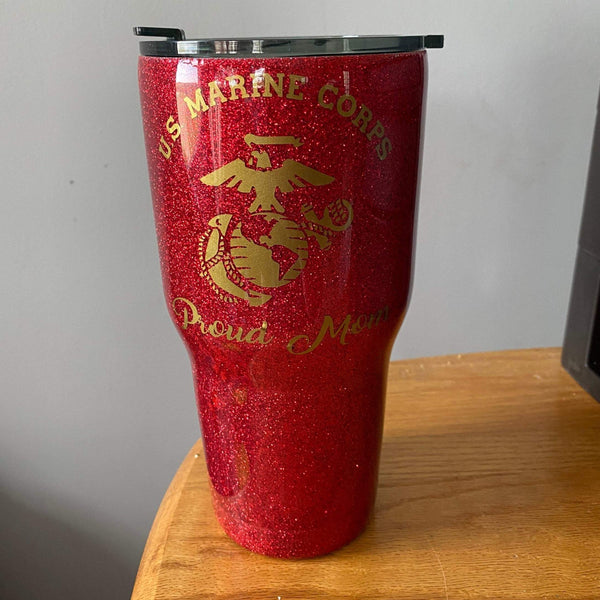
There's a reason the yellow footprints have stayed such a powerful image for over half a century—they mark the precise line between "before" and "after," for your recruit and, in a quieter way, for you too. A lot of Marine moms find themselves wanting something small to mark that same line: the day everything changed, even if you weren't standing there to see it.
If you're looking for a way to hold onto that moment, our Marine Mom collection has pieces made for exactly this kind of milestone—from the day they leave, through every phase that follows.





FAQ: The Yellow Footprints Ceremony
What are the yellow footprints at Marine boot camp? They're rows of footprints painted outside the recruit receiving building at both Marine Corps recruit depots, marking the spot where every recruit takes their first step toward becoming a Marine.
Why are the footprints painted at an angle? The 45-degree angle matches the position of attention—the basic standing posture every recruit is taught, starting with where they first stand.
Do parents get to watch their recruit step on the yellow footprints? No. This happens late at night after recruits arrive by bus, well after the goodbye between parent and recruit has already taken place, usually at a hotel or processing station earlier that day.
How long have the yellow footprints been a Marine Corps tradition? Since roughly the mid-1960s—the exact date isn't officially documented, but the earliest known photos date to the early-to-mid 1960s.
How long until I hear from my recruit after drop-off? Most recruits get one short phone call during receiving to confirm safe arrival, followed by silence until their first letter—typically within the first one to two weeks.
Is this the same for both Parris Island and San Diego? Yes. Both depots use the same tradition and the same scripted welcome, just in different locations.
Just said goodbye and not sure what's next? Here's the full week-by-week map of Marine boot camp, and here's what to know about sending your recruit's first care package.